Report: ‘Severe Population Loss’ In Micronesia
Report to Congressional Committees from GAO, May 2026 (excerpts)
Economic conditions in the Freely Associated States (FAS)—the Federated States of Micronesia (FSM), Republic of the Marshall Islands (RMI), and Republic of Palau—include population loss and economic decline. FSM’s population decreased by 26 percent between the 2010 and 2023 censuses, and RMI lost 20 percent of its population from 2011 to 2021. U.S. and FAS officials said high levels of out-migration have exacerbated skilled labor shortages and rising costs for government services. Though Palau’s population has remained relatively stable, a sharp drop in tourism during the COVID-19 pandemic drove a decline in its gross domestic product from 2019 through 2022.
The three countries plan to use compact funding to prioritize education and health. Their allocations of compact grants for fiscal year (FY) 2025 largely support personnel salaries in the education and health sectors, and the countries plan to use compact infrastructure funds for projects that include schools and hospitals. However, FAS officials told GAO that project implementation has encountered obstacles such as delayed compact funds disbursement, rising construction costs, and labor shortages.
The FAS have not yet met certain oversight requirements established by the amended compacts, while U.S. oversight efforts are underway with some delays. Most documents that FSM, RMI, and Palau are required to submit were not submitted on time, and some remain outstanding. For example, since FY 2019, all three countries’ required single audit reports—critical to U.S. compact oversight efforts—have been late. FAS officials said they are taking steps to improve the reports’ timeliness, such as by increasing financial accounting capacity. U.S. agencies have begun to implement oversight efforts. For example, the U.S.–FSM and U.S.–RMI joint management and accountability committees met in August 2025. However, delayed U.S. appointments to these committees affected members’ ability to discuss all planned issues. Also, the Interagency Group on the Freely Associated States submitted its FY 2024 report on its activities and recommendations for compact implementation to Congress 10 months late. State Department officials told GAO that plans to establish and staff a unit to support FAS relations and compact implementation by March 2029 had been paused due to the federal government’s hiring freeze and operational constraints.
…
The U.S. relationships with the FAS began when American forces liberated the islands from Japanese control near the end of World War II. In 1947, the U.S. entered into a trusteeship with the United Nations and became the administering authority over FSM, RMI, and Palau.[5] FSM and RMI remained subject to U.S. authority until 1986, when each entered into a compact of free association with the U.S.;[6] Palau’s compact with the U.S. entered into force in 1994.[7]
Since those dates, the U.S. and FAS have amended a series of compact agreements (see fig. 2).[8] Under the compacts, the U.S. has provided economic assistance for defined periods; has assumed responsibility for the defense and security of each state; and has allowed eligible FAS citizens to enter, establish nonimmigrant residence in, and engage in occupations in the U.S. notwithstanding certain visa and labor certification requirements of the Immigration and Nationality Act[9] under specific circumstances.[10]
…
FSM and RMI Have Experienced Significant Population Loss and Some Economic Decline Since 2010
Out-Migration Has Led to Substantial Population Loss in FSM and RMI
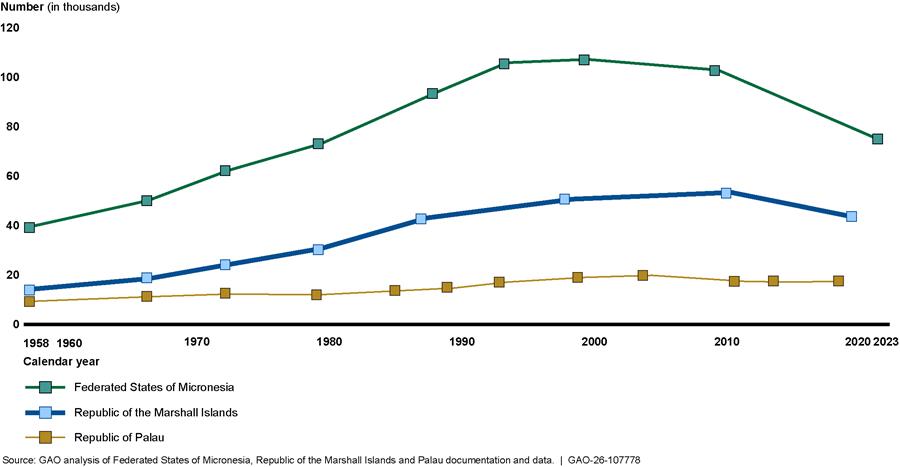
The populations of FSM and RMI have declined significantly over the past decade, while Palau’s population has remained relatively stable (see fig. 5). FAS citizens often migrate to the U.S. and its territories seeking improved health services, educational opportunities, and jobs, among other things.
Figure 5: Populations of Freely Associated States, 1958–2023
The following describes recent population trends in the three countries:
· FSM. FSM’s population decreased by 26 percent between the 2010 and 2023 censuses, falling from 102,843 to 75,817. FSM officials estimated the population in 2025 to be between 70,000 and 80,000.[24] State officials estimated that FSM’s 2025 population was likely less than 70,000. Micronesians move internally and abroad for better-paying jobs, educational opportunities, and access to health services, according to FSM officials.
· RMI. RMI’s population decreased by 20 percent between the 2011 and 2021 censuses, falling from 53,158 to 42,418. U.S. and RMI officials estimated that RMI’s population had fallen further, to between 33,000 and 36,000, since its 2021 census.[25] Such losses represent the first population decline for RMI since its 1958 census. According to RMI government officials, migration from the outer island communities to the urban areas of Majuro and Ebeye and abroad is substantial, with 70 percent of these communities experiencing large population decreases. Some outer islands’ populations are less than a third of their reported populations in 2020. As in FSM, this migration is often driven by a relative lack of economic opportunities, according to RMI and U.S. officials. Few jobs are available in the outer islands, and full-time opportunities are usually limited to teacher or health-assistant positions. In addition, skilled workers often leave for better-paying jobs abroad, and training programs often lead to further international migration, according to officials.
· Palau. After losing 12 percent of its population between the 2005 and 2012 censuses, Palau’s population remained relatively stable, around 17,500, between its 2012 and 2020 censuses. According to Palau government officials, Palau maintained its population levels in recent years because its economic activity gave residents an incentive to stay.
Our analysis of data from CBP’s Arrival and Departure Information System indicated a recent increase in FAS migration to the U.S.[26] Specifically, we found that from 2017 through 2024, almost 48,000 more FAS citizens arrived in the U.S. and its territories than left them.[27] As figure 6 shows, the net number of compact migrants to the U.S.—mostly FSM citizens—substantially increased in 2021 during a period when, according to State, entry into the FAS was restricted because of the pandemic.
Figure 6: Annual Net Arrivals from Freely Associated States (FAS) to U.S. Areas, 2017–2024
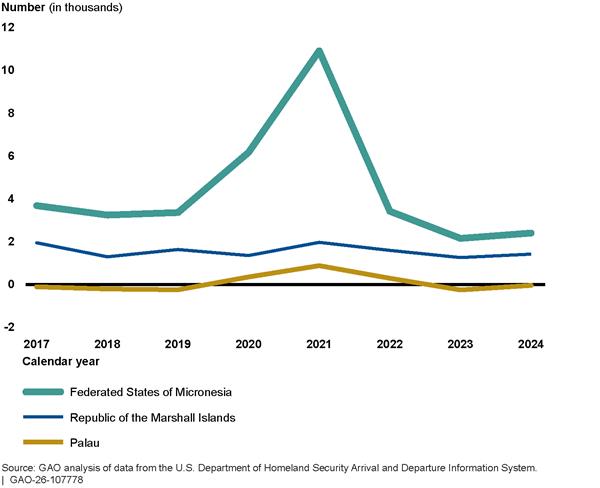
Note: We calculated net arrivals as the difference between FAS citizens’ arrivals in the U.S. (including territories) and FAS citizens’ departures from the U.S. (including territories). We excluded land arrivals and departures because the FAS do not share a border with U.S. areas and because, according to officials, data on land departures are less accurate. A negative value in annual net arrivals indicates a net departure of FAS citizens from the U.S. and its territories.
Population Loss Has Affected FAS Labor, Services, and Government Finances
FAS and U.S. government officials noted that FAS citizens’ out-migration has limited the availability of skilled labor and affected the cost and demand for public services as well as the FAS governments’ revenues and allocation of funds.
Availability of skilled labor. Out-migration has contributed to skilled labor shortages in both FSM and RMI, particularly in the construction sector, according to officials. For example, FSM government officials told us that a hospital project in Kosrae relied on nonlocal contractors due to shortages of skilled labor and construction workers. Similarly, RMI officials said that construction companies rely on workers from the Philippines to meet skills gaps. FSM and RMI officials noted that graduates of training programs often leave for higher-paying positions abroad. Palau officials noted that similar difficulties in retaining skilled labor in the private and public sectors had resulted from the high levels of migration to the U.S. and its territories for better pay and access to health services.
Cost and demand for public services. High levels of out-migration increase the per-capita cost of delivering services, such as education and health care, making those services more difficult for the government to provide. According to FSM and RMI officials, out-migration has resulted in smaller numbers of students and teachers per school, particularly in the outer islands, where some schools in RMI now have fewer than 10 students....
read … FULL REPORT
CB: Labor Shortages Stymie Building Of Schools, Hospitals In Micronesia - Honolulu Civil Beat