Oswald Stender: A Model of Fiduciary Duty
by OHA Trustee Keli‘i Akina, PhD, Ka Wai Ola, August 1, 2026
The first person to ask whether I would ever consider becoming an OHA trustee was Oswald Stender, who himself served as an OHA trustee from 2000 to 2014. Uncle Oz, as he was affectionately known, regularly welcomed me and my students from the Center for Tomorrow’s Leaders (CTL) to OHA’s offices. During those visits, he generously shared his time and spoke with us about leadership and public service.
It was in these meetings with Trustee Stender that I learned my first lessons about OHA. Uncle Oz passed on his manaʻo about the Public Land Trust, the Akaka Bill, Hawaiian nationhood, and a concept essential to being a trustee: fiduciary duty.
A trustee’s fiduciary duty is the legal obligation to act in the best interests of the trust and its beneficiaries, rather than in the trustee’s own interests. This is one of the highest duties recognized by law.
Stender was the epitome of fiduciary duty throughout his service as a Kamehameha Schools Bishop Estate (KSBE) trustee from 1990 to 1999. His story is chronicled in Broken Trust: Greed, Mismanagement & Political Manipulation at America’s Largest Charitable Trust by Randall Roth and Samuel P. King.
Many remember 1999 as the year KSBE imploded. Four of the five trustees overseeing the $6 billion trust were ultimately removed for breaching their fiduciary duties. Uncle Oz took a different path. He voluntarily resigned, walking away from his $1-million-a-year salary because protecting Princess Pauahi’s legacy mattered more than holding office.
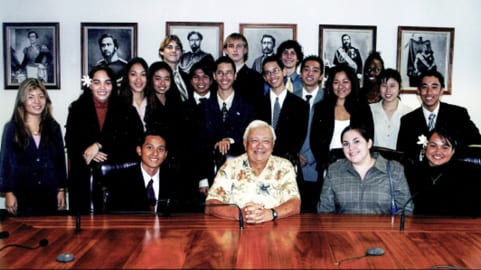
One of the most cherished photos in my OHA office, featuring Oswald Stender with the 2005 class of CTL Fellows. A gift from Lei-Ann Stender Durant, Uncle Oz’s daughter. – Courtesy Photo
That decision taught me the first and perhaps most important fiduciary duty: loyalty.
The duty of loyalty means putting beneficiaries’ interests above your own. Personal ambition, prestige, and compensation must take a back seat to the purpose of the trust. When the IRS threatened Kamehameha Schools’ tax-exempt status, Uncle Oz didn’t fight to keep his job. He offered to resign if it meant protecting the trust.
Uncle Oz also exemplified the fiduciary duty of care.
The duty of care means a trustee doesn’t look the other way when there’s wrongdoing, even within the board. When he believed fellow trustee Lokelani Lindsey was mismanaging Kamehameha Schools and misusing trust assets, he didn’t stay silent. He sued to have her removed, and the court ultimately agreed.
He understood the duty of obedience as well.
The duty of obedience means carrying out the trust exactly as its creator intended. Uncle Oz tested every decision against Princess Pauahi’s vision for educating Native Hawaiian children.
Finally, Uncle Oz demonstrated the fiduciary duty of good faith.
The duty of good faith means taking responsibility to protect the trust. Although Uncle Oz tried to stop the board’s misconduct, he still accepted responsibility in the IRS settlement, paying excise taxes that helped Kamehameha Schools recover millions of dollars. That sacrifice, along with voluntarily resigning from his position, was an act of good faith.
Uncle Oz demonstrated that fiduciary duty is much more than a legal obligation. It’s about making difficult decisions when they’re unpopular. It’s about putting beneficiaries first. And it’s about having the courage to speak up when something is wrong. Those lessons have shaped my understanding of what it means to serve as an OHA trustee.